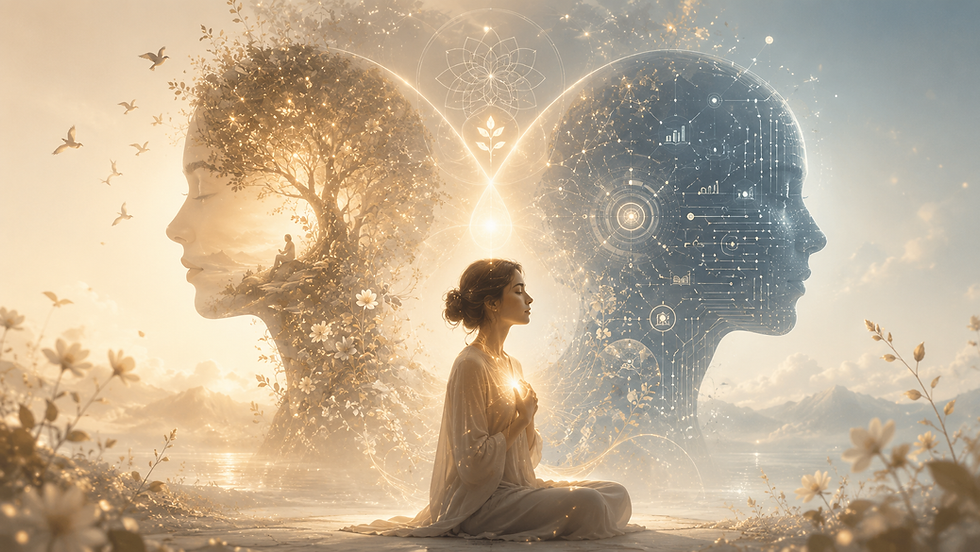
From Personalization to Human Unfolding
Updated: Jul 27
Rethinking the Purpose of Personalization

In recent years, personalization has become one of the defining ambitions of educational technology. Learning systems are increasingly able to understand learners' preferences, estimate their level of understanding, adapt to their pace, and tailor educational experiences to their individual needs.
This marks an important step beyond the traditional one-size-fits-all model, where every learner was expected to follow the same path.
Yet an important question remains:
Is it enough for a system to know what a person needs today?
At its core, personalization responds to what is already known.
Human growth, however, always extends beyond what is already visible.
People do not discover themselves all at once, nor can their potential be defined by what they have demonstrated so far. Within every individual may lie interests that have never been explored, abilities that have never encountered the conditions needed to emerge, and questions that have not yet taken shape.
From this perspective, perhaps the deeper purpose of intelligent systems is not simply to adapt to people as they are, but to help them discover who they are capable of becoming.
This is where I introduce the concept of Human Unfolding.
Human Unfolding is not about optimizing performance or creating a more efficient version of the self. It is an ongoing journey through which human beings gradually reveal their unique potential through learning, experience, reflection, relationships, and the experiences that shape their lives.
It is a journey in which people discover not only the world around them, but also themselves.
From this perspective, artificial intelligence becomes more than a system that delivers increasingly personalized content or more accurate answers.
It becomes an environment that helps people recognize possibilities they have not yet seen, expand the questions they ask, and accompany their continuing journey of self-discovery—without prescribing who they ought to become.
Perhaps this is the fundamental distinction between personalization and Human Unfolding.
Personalization helps people reach what they already want.
Human Unfolding also helps them discover what they never knew they could become.
Perhaps everything we have explored so far leads us to one final question:
If artificial intelligence can accompany the journey of human unfolding, what principle should guide its design?