Do We Shape the Next Generation... or Nurture Their Growth?
Updated: Jul 27
Rethinking the Role of Parenting and Education
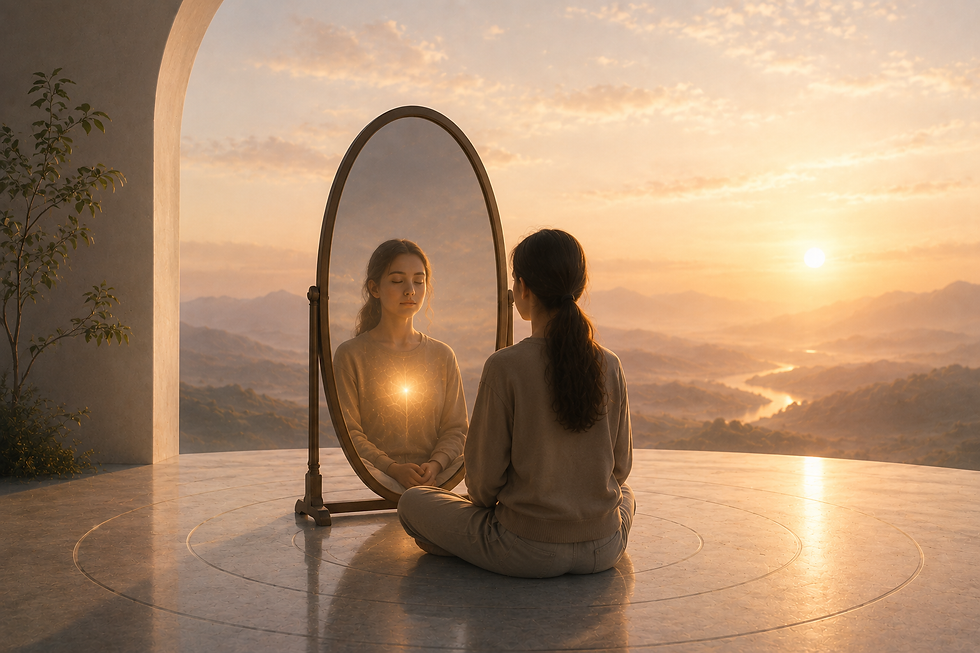
Educational discourse is filled with expressions that have become so familiar we rarely stop to question them.
We speak of parents "shaping" their children. We describe education as the process of forming a child's personality. These ideas are so deeply embedded in our language that they often pass unquestioned.
But do they truly reflect what is happening?
If every human being enters the world carrying unique potentials, dispositions, and capacities, then education begins to look less like an act of construction and more like an act of cultivation.
A child does not arrive as a blank slate in the simplistic sense the phrase is often understood. Nor do they arrive as a finished product that no longer requires guidance. Rather, they come into the world with possibilities of their own, while education, parenting, and life experience shape the conditions under which those possibilities can unfold.
From this perspective, the question is no longer:
How do we create the child we want?
Instead, it becomes:
How do we create the conditions in which every child can become a fuller expression of who they already have the potential to be?
Far from diminishing the importance of family, this perspective gives parents an even more meaningful role.
Parents and educators do not implant a child's personality. Instead, they cultivate the environment that offers safety, acceptance, opportunity, experience, and meaningful challenge—the conditions through which each child's individuality gradually unfolds.
Perhaps this explains why two children raised in the same home, receiving the same upbringing, can grow into remarkably different adults.
Not because parenting has little influence, but because its influence is always shaped by the uniqueness of the individual it encounters. Education does not act upon identical raw material. It meets a different human being every time.
Viewing education as the nurturing of growth rather than the manufacture of human beings frees us from the illusion of complete control while restoring education's true responsibility.
We are not responsible for determining who our children become.
We are responsible for creating the conditions in which they can grow into themselves as fully as possible.
Seen in this light, parenting also becomes less burdened by impossible expectations.
Success is no longer measured by whether children become reflections of our hopes or extensions of our ambitions. It is measured by whether each child finds their own path toward maturity while experiencing security, belonging, and the freedom to become themselves.
Perhaps this invites another question.
If education accompanies the journey of growth rather than creating it...
What happens when human beings begin searching for their identity for themselves?