Is the Human Being Like a Seed?
Updated: Jul 27
Rethinking Human Development
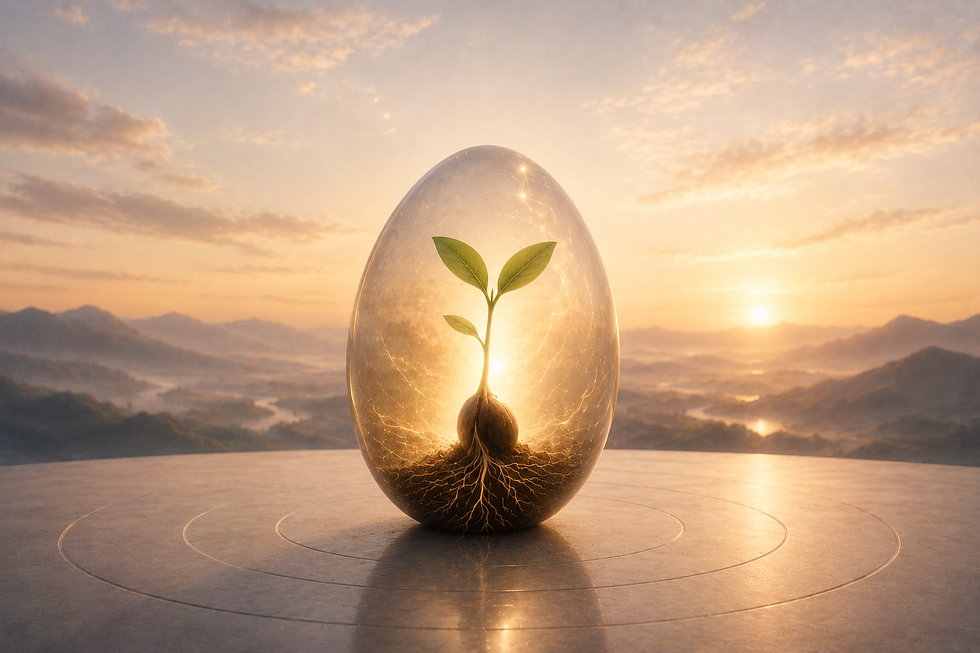
The seed is often used as a metaphor for growth. Yet its value lies not in the comparison itself, but in the question it invites us to ask.
A seed does not contain a fully formed tree. It contains the possibility of one.
No one can add its essence from the outside. The most we can do is create the conditions that allow what is already there to emerge.
Could this metaphor help us rethink the way we understand human beings?
Viewed through this lens, growth may not be a process of constructing a person from the outside as much as it is a process of revealing what already exists within.
This does not diminish the importance of environment, parenting, education, or life experiences. On the contrary, they profoundly influence the course of human development. They can expand or constrain possibilities, nurture strengths or suppress them. What they cannot do, however, is create a person's uniqueness from nothing.
The distinction between these two perspectives is fundamental.
If we assume that human beings are entirely made, education naturally becomes a project of shaping people according to a predefined model of what they ought to become.
If, instead, we begin with the assumption that every person already carries unique potentials within them, then the purpose of education changes. It is no longer to manufacture the human being, but to accompany the unfolding of their growth.
This shift does not reduce the value of education. It redefines it.
Teachers, parents, and educational institutions cease to be manufacturers of human beings. Instead, they become partners in creating the conditions in which each person's abilities, interests, questions, and character can emerge in their own authentic way.
Perhaps this perspective helps explain why two children respond differently to the same experience, why some individuals flourish in environments where others do not, and why human development can never be reduced to a single formula that works for everyone.
Recognizing that every individual possesses inherent potential does not imply that the future is predetermined. Rather, it suggests that every person begins from a unique point of departure, and that no two journeys of growth are meant to be identical.
From this perspective, perhaps the most important question is no longer:
How do we create the human being we want?
But rather:
How do we create the conditions that allow every human being to become a fuller expression of their own unique potential?
This, in turn, prompts another question:
If human beings already carry their potential within them... What, then, is the true purpose of education?