Less to Unfold More
Updated: Jul 27
Rethinking the meaning of learning
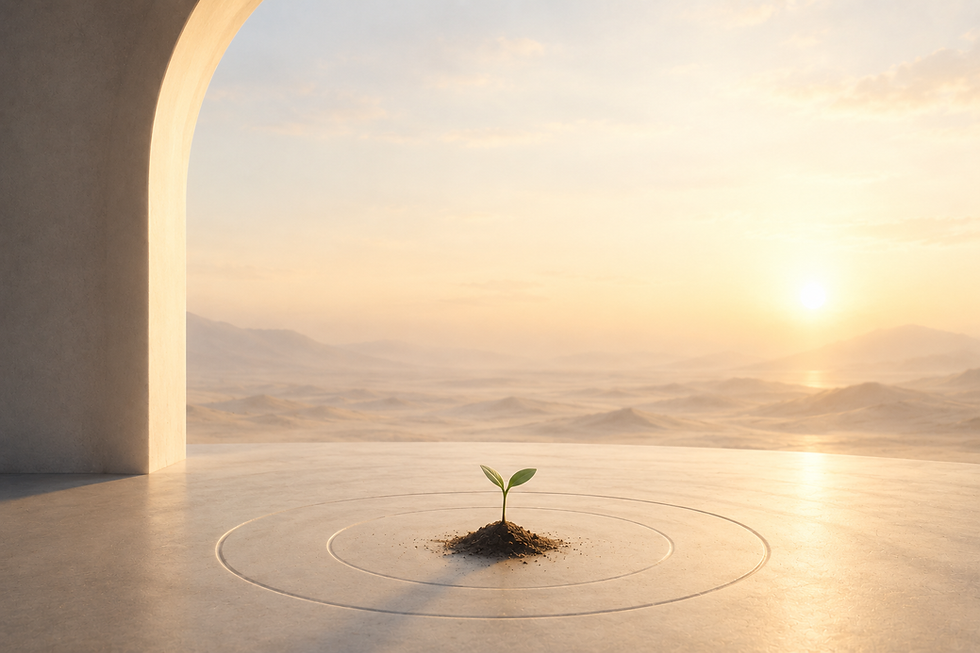
Much of our understanding of progress has long been shaped by the idea of addition.
We acquire knowledge to become more informed, develop new skills to become more capable, and create more tools to become more efficient. This mindset has also shaped our educational systems, where the quality of learning is often measured by what is added to the learner, rather than by the space created for discovery.
But what if this assumption is incomplete?
What if the more important question is not, What should we add? but rather, What should we make room for?
Many of our most original ideas do not emerge in moments of fullness, but in moments of spaciousness; when the constant flow of sensory input begins to quiet, when the noise recedes, and when we finally have enough room to reflect and connect what we know with what we truly experience.
Perhaps this invites us to rethink learning itself.
Learning is not merely the accumulation of information, just as a human being is not a container whose growth can be measured by how much it holds. When education is reduced to continuous addition, it risks overlooking a deeper purpose: creating the conditions in which meaningful questions arise, curiosity awakens, and human potential finds the opportunity to unfold.
From this perspective, Less is not a call to reduce knowledge, ambition, or intellectual rigor.
It is an invitation to reduce everything that competes with genuine learning: the constant fullness that leaves little room to think, to reflect, to discover, or to listen to what is quietly taking shape within.
Perhaps what we lack today is not knowledge itself, but the space that allows knowledge to become understanding.
Profound questions require time before they can fully emerge. New ideas need space in which they can grow. And every human being, from time to time, needs to stop adding more in order to see more clearly what is already present.
Perhaps the greatest challenge in education is not learning how to add more.
Perhaps it is learning how to create enough space for what could never emerge in the midst of constant fullness.
Perhaps we cannot move forward without first pausing to consider one more question...
If we hope to build a more human-centered education, shouldn't we first ask the most fundamental question of all:
Who is the human being we are trying to educate?