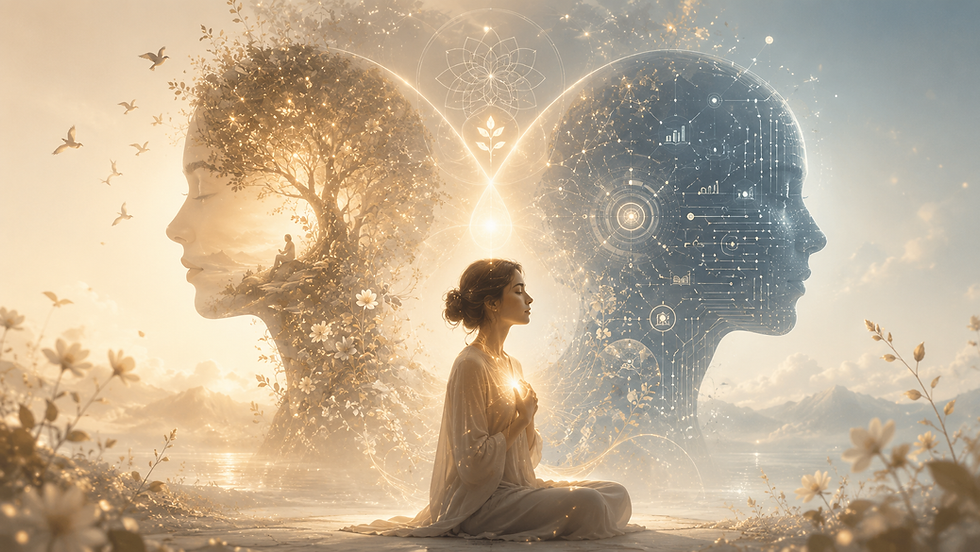
Where Everything Begins: The Human Being
Updated: Jul 27
Rethinking the Conception of the Human Being in Education

Around the world, tremendous effort is being invested in reimagining education, advancing artificial intelligence, and developing systems that can better support learning and decision-making. As these fields continue to evolve, one question repeatedly takes center stage:
How can we make these systems more effective?
Yet behind this question lies another—less frequently asked, but arguably more fundamental:
Who is the human being these systems are ultimately designed to serve?
This is far more than a philosophical exercise. It is the foundation upon which every educational philosophy, every AI system, and every framework for assessment or human development is built. Whether acknowledged explicitly or not, each carries an underlying assumption about what it means to be human.
Are human beings something to be shaped entirely from the outside? Or does every individual already possess unique possibilities waiting for the right conditions to emerge? Is education primarily about forming people according to predefined models, or about helping them discover what is uniquely their own?
The answers to these questions reach far beyond education. They influence how we design technologies, define success, and ultimately understand human development itself.
This article begins with a simple proposition with profound implications:
"Human beings are not projects to be constructed; they are beings that unfold."
This perspective does not diminish the importance of environment, education, or lived experience. Rather, it invites us to see them as conditions that shape the course of development, rather than forces that create human uniqueness from nothing.
Once we adopt this perspective, the central question changes.
Instead of asking, How do we build better human beings?
We begin asking, How do we create the conditions in which each person can unfold according to their own uniqueness?
Perhaps this is where genuine transformation begins.
Rather than producing individuals who increasingly resemble one another, the goal becomes helping every person discover who they are, cultivate their unique potential, and contribute to the world through their individuality rather than despite it.
Viewed from this perspective, the first step toward transforming education is not redesigning curricula, developing more sophisticated technologies, or creating new tools.
It is rethinking the human being.
Because the way we understand human beings ultimately shapes everything else we choose to build.
Yet before we go any further, one more question deserves our attention:
If every human being is inherently unique, why do we continue to measure everyone by the same ruler?